In that stampede to identify with what, from our history’s landmarks, makes us feel Welsh today.
The more recent, more glamorous, more obviously recognisable landmarks, people, stories or moments; rugby player, rebel prince, miner, magician, portal dolmen or black and white Pathe News politician.
Unless they’ve had the privilege of being taught by Milford Grammar’s jewel in the crown, Mr Grenville ‘Buddha’ Thomas, most who roar past in their cars today, on the way from Pembrokeshire to St Clears and the great wide world beyond, will hardly give the blur that is Llandowror a second glance.
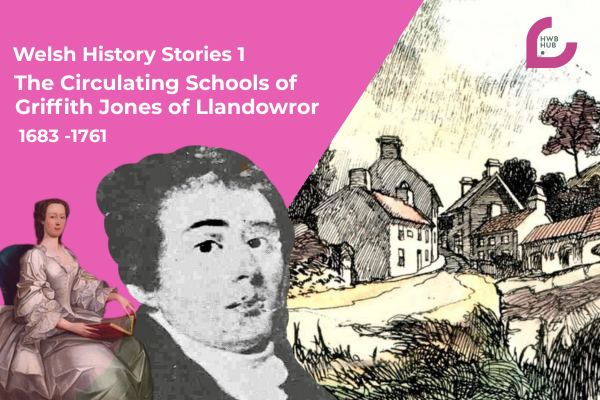
It’s just that church isn’t it? A road sign. Oh, and horses grazing in that field over there. Yet it was from this very village in the 1730s that, unlikely as it now may seem, a certain clergyman launched an educational revolution that took Wales, and, you could argue, the rest of the world by storm. That clergyman was one Griffith Jones, Griffith Jones of Llandowror and it was from Llandowror that he began his Circulating Schools, the Circulating Schools of Griffith Jones of Llandowror.
The Achievement
It’s the 22 September 1731. A Saturday. Your rusty time machine has landed in Llandowror from the year 2025 with a shudder, a bump and a spilling of tea on the dial now showing 1731, as it gasps finally quiet, just in time for you to see the Reverend Jones, 47 years old, and not in good health, finally set up the very first Welsh speaking Circulating School. Fast forward to 1740 and he’s established 128 schools. With 7,595 pupils. Across the rest of Wales. Just 21 years later, in 1761, the year Jones dies, the numbers have become truly mind blowing. 3,495 schools. 1600 locations. 158,237 people taught.
At a time when the population of Wales is around 450,000, Professor John Davies estimates the number of those who have benefitted from the Circulating Schools as even higher: around 200,000, since the official number doesn’t take into account those only able to attend in the evening after work. It’s a figure, of course, that represents almost half the entire population of the country, and one that makes Wales one of the most literate nations in Europe, one of the few to have a literate majority.
The Context
The achievement is especially staggering when you appreciate the context, the society from which it is born.
If you’d travelled back in time just a little further, to the early 1700s, you’d soon be shocked to discover an age which boasts no compulsory education, none whatsoever, an era when the majority of working-class people can neither read nor write. There is scepticism even towards the idea of creating a state education system. Many believe education is a form of charity not a right.
In rural areas children are employed to help with farm work. In industrial areas you can find them in the ironworks, in the mines, eyes looking out at you startlingly white from faces blackened with coal dust and exhaustion. Child labour is commonplace. It is well paid. Many parents see schooling as unnecessary.
A farm labourer in Cardiganshire with six illiterate children paints the picture perfectly when he tells a Commission,
There is no school in the parish where I live, and if there was I could not afford to send my children to it. I never get meat, except now and then a bit of bacon. I live upon potatoes, bread and cheese, and a little butter. The labour of children becomes valuable after 10; a boy of that age can earn a good wage, besides getting his meals at the farm house. Education is a good thing, but bread for a poor man is better
No wonder that Welsh education historians Gareth Elwyn Jones and Gordan Wynne Roderick describe the Circulating Schools as
among the most important educational experiments anywhere in Europe in the eighteenth century
No wonder that the success of the project attracts the interest of reformers and educationalists all over Britain, before Catherine the Great, Empress of Russia, catches wind of it and is inspired to commission a report on Griffith Jones' Circulating Schools in 1764, with a view to creating a similar system in her own country.
But how have on earth have these schools come about?
How do they work?
How are they received?
And who the heck is this Griffith Jones fella?
The Life of Griffith Jones
He was widely acknowledged as one of the greatest masters of the Welsh tongue, that ever Wales was blessed with (John Dalton)
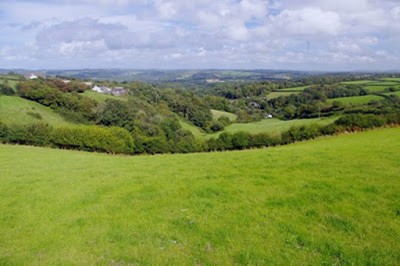
Above: Griffith Jones' birthplace
Born in 1683 at Pant-yr-Efail, a small, isolated farm on the hillside above Nant Bran in Cwmhiraeth, Penboyr parish in Carmarthenshire (just a year before the death of his father), Grifith Jones dies in Laugharne on the 8th April 1761, ‘full of piety and full of days,’ later to be buried at the church in Llandowror.
It is safe to say his 77 years on this planet between those two dates have a huge impact.
Those years are shaped irrevocably by his early work as a shepherd because it’s on the hills alone with his flock where he has the profound spiritual experience, a vision, which fuels the religious vocation from which his impact, his achievements spring. He is soon accepted into the church and ordained a deacon despite never having enjoyed a university education.
A close friendship with Sir John Phillips of Picton (1666-1737) also has a profound influence on Jones’ life. Through Phillips he is introduced the SFPK, The Sociey For the Propogation of Christian Knowledge, becomes a member himself, and his own Circulating Schools are at least in part inspired by the earlier English language SFPK schools. Through the SFPK’s links with the German Pietist movement and a correspondence with Jakob Boehme and Herman Francke, Jones nearly becomes the first western missionary to visit India, but, during a postponement to the journey, during which he preaches in front of Queen Anne, he decides the priority is the spiritual needs of his own country, a conviction only intensified by what he sees for himself on a tour around Wales as part of a trip to Scotland with Sir John.
Driven by a sense of urgency for the ordinary person to hear the preaching of the gospels, the same sense of urgency which is eventually to be fulfilled in the establishment of his Circulating Schools, Jones, according to one Thomas Rees, soon becomes,
justly regarded as the greatest preacher at that time in the Principality
This is a period characterised by absentee bishops and clergyman who brazenly neglect their parishioners and their duties, a neglect which is soon to inspire that religious and social movement across the country that is the Methodist Revival.
One of Jones’ biggest critics, the neighbouring vicar, John Evans, is typical. Evans has no sympathy for the needs of the people entrusted to his care and makes no bones about it, openly regarding the Welsh as
a generation of people, besotted by profaneness, and benighted in ignorance
Like many others, he rarely visits the two parishes in Wales for which he has responsibility, preferring to carry out his regular duties as a Reading Chaplain at the Chapel Royal in Westminster, returning home shamelessly but once a year to receive his tithe.
It is in this religious vacuum that a man of Jones’ learning and vocation thrives, and even before he’s preferred to the parish of Llanddowror in 1716, he’s already become famous for his preaching.
More significantly and more precisely, he’s famous for the quality of his preaching and for roaming the land far and wide well beyond the bounds of his own parish, to wherever he has an invitation to preach, if not from the local clergy, then from some of the more influential members of those parishes.
Excited crowds, many of them bored by the tedious homilies of their pastors, go to some pains to hear him. John Dalton estimates his congregations to be
above five and six hundred auditors, nay sometimes 1,000, a number not to [be] met with in Wales
Sir John Philipps puts the figure as often between 3-4,000.
Attracting multitudes from neighbouring counties and from as far afield as north Wales, Herefordshire and Monmouthshire, Griffith Jones becomes widely acknowledged as
one of the greatest masters of the Welsh tongue that ever Wales was blessed with
Jealous of his success, local clergy deny him access to their pulpits to preach, thus forcing him to speak in the open air to the large crowds who come to hear him, a style of preaching which, in many ways, is a forerunner to the style of preaching that comes to characterise the next generation of Methodist preachers.
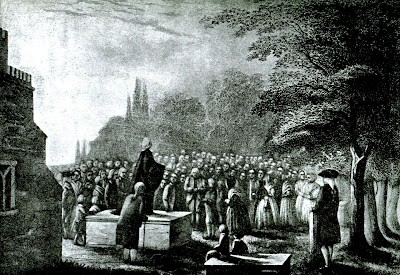
Above: Griffiths Jones preaching in a churchyard
An eyewitness describes how Jones brings his sermons to a close:
He seems to summon up all his remaining force; he gives way to a superior burst or religious vehemence and, like a flaming meteor, does bear down all before him
When Jones is obliged to defend his roaming and preaching in other parishes to the Bishop of St Davids at a formal hearing, he paints a picture of the inadequacy of the local clergy who hoodwink their flock with stupidity, suggesting that the bishop would be better served in,
stirring up those that preach, not in silencing those that do
The Bishop is persuaded.
Jones is preferred to the parish of Llandowror.
All the elements of his life are finally in place for the birth of the Circulating Schools
The Circulating Schools
Since he believes that people’s ability to find salvation comes directly through knowledge of the gospel, Jones’ determination to follow through his idea of developing the Circulating Schools is heightened by the smallpox epidemic (1727-1730) which takes the lives of many of his parishioners.
Thinking further on this situation, according to Thomas Rees, and spurred on by his parishioners’ lack of knowledge when tested at communion in his church at Llandowror, Jones recognises the need for people to develop their religious knowledge and understanding.
Though initially he regards it as no more than a pipe dream, slowly his idea, of seeing 'a well-organised system of schools extended over the whole surface of his native country,' starts to crystalise.
In 1734 Jones sets about organising a system to teach children and adults basic reading skills in their mother tongue in as short a time as possible, creating a series of schools that rotate or circulate around the rural parishes of Wales, mainly in the winter months when farm work is relatively slack. The schools stay in one place for approximately three to six months (or until such time as pupils have mastered the necessary skills), make use of churches, chapels, barns and farms to keep expenses to a minimum, and then move on to another location. Dozens of men, women and children flock to the schools, and though around two thirds of those attending are adults, pupils range in age from about six to seventy or more. Together in the flickering light of rush candles, all learn by heart key passages from the Welsh bible of William Morgan.
Though the schools are 'generally welcomed and kindly received everywhere,’ Griffith Jones is not without his critics, many disagreeing with teaching ordinary working men and women to read, particularly reactionary clergymen who feel that their position at the centre of the community is being undermined.
In fact, there is also extensive evidence of teachers being persecuted, especially in the north of the country which fosters a deep hostility towards Methodism. The experience in 1744 in Caernarvonshire of 23 year old Evan Williams, a teacher from south Wales, was typical if extreme.
Just two days after starting a Circulating School in the Lleyn, Williams is beaten with sticks by a mob, a mob actually egged on by the local vicar. Managing to escape, he is pursued and searched for by a gang of 30 men, eventually discovered and beaten again, but runs five miles barefoot and is nearly drowned in a tidal river which he is forced to swim at full flood in fear of his life, managing to escape a second time. His health broken, however, as the result of his injuries, he dies just four years later and is effectively considered a martyr for the cause of the Circulating Schools.
Nevertheless, the enthusiasm for the schools shown by the vast majority is clear and captured by one writer who talks of
the insatiable longing of the common people to learn to read…the blind, the lame, the disabled and the old, came to the schools and wept for joy for the privilege
Indeed, there is evidence of at least one old lady who is completely blind attending her local school simply because she loves to hear the young children being taught, remaining to learn for herself the Lord's Prayer and the Ten Commandments.
Funded by wealthy patrons, these travelling schools reach almost every part of Wales. The language taught is usually Welsh, although English is used in areas such as south Pembrokeshire.
But Jones almost certainly could not have found such success without the staunch, lifelong support of friend and confidante Bridget Bevan (1698-1779), the influential and wealthy wife of barrister and MP Arthur Bevan, who had died in 1743. The two strike up a close friendship and it is Bevan who chiefly carries on the work of his Circulating Schools after his death using the £7000 he leaves her in his will to faithfully continue the project for another 18 years until her passing in 1779.
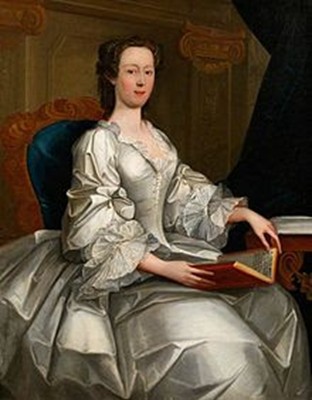
Bridget Bevan: friend, confidante and supporter of Griffith Jones
Gwladys Jones is surely correct when she says of the man who personally fed, clothed and doctored many of his needy parishioners,
It would be difficult to exaggerate the importance and effect of the charity school movement upon the history and character of the Welsh people
However, perhaps it is Professor E. Wyn Jones who best sums up Jones' impact,
Jones’s prime concern was the spiritual enlightenment of the Welsh people, and he and his educational movement were crucial in making the Bible and orthodox Protestant Christianity central to the lives of an increasing number of Welsh men and women as the eighteenth century progressed; but his work had other long-term consequences for Welsh life and culture which he would probably not have foreseen, nor sometimes even welcomed. In many ways, the flourishing of Methodism and evangelical Nonconformity, the preservation of the Welsh language, the strengthening of Welsh national identity, and the growth of radicalism, factors which between them created the radical, Nonconformist, Welsh-speaking culture that characterized much of Welsh life by the mid nineteenth century can all be traced back to his charity-school movement. It is certainly no exaggeration to describe Griffith Jones as ‘one of the prime makers of modern Wales and one of Britain’s most notable educational pioneers’
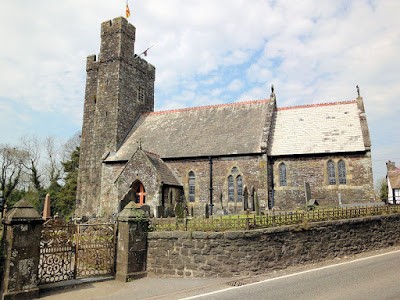
The church at Llandowror: centre of an educational revolution
Sources
Mr Grenville ‘Buddha’ Thomas, ‘Assorted Milford Haven Grammar School Notes.’
Professor John Davies, ‘A History of Wales.’
David Edward Pike, ‘Griffith Jones: Revival’s Morning Star.’
Dean Jones, ‘A Friend and Spiritual Father: Griffith Jones, Bridget Bevan, and The Circulating Schools of Wales.’
Phil Carradice, ‘Griffith Jones and the Circulating Schools.’
‘The Story of Wales,’ BBC TV Series
Revd Ivor J. Bromham, ‘Welsh Revivalists of the Eighteenth Century.’
Gwladys Jones, 'The Charity School Movement: A Study of Eighteenth Century Puritanism in Action’
Professor Wyn Jones, ‘Griffith Jones (1684–1761) of Llanddowror and his ‘Striking Experiment in Mass Religious Education' in Wales in the Eighteenth Century’